
7 October 2019 – 13 October 2019
- Make flashcards with Korean words and phrases

This past week, I embarked on the Korean language segment of my project as I tried to create flashcards with Korean words and phrases. In fact, this task was especially timely because Korea’s Hangul Day coincidentally falls on October 9. It is a national Korean commemorative day marking the invention and the proclamation of hangul, the alphabet of the Korean language.
To celebrate and mark this special day, K-pop boy group, Seventeen, hilariously attempted to say their group introduction in Korean when they usually do it in English, with comical results:
For this week’s blog update, I decided to name it “Hello” after NU’EST’s song of the same name. Although its Korean song title is “여보세요” or “Yoboseyo”, which refers to a greeting used by Koreans to answer phone calls instead of the actual greeting used to say hello, “안녕하세요” or “Annyeonghaseyo”, I thought the fact that it is also a very basic Korean phrase ties in well with the content of this week’s topic of the Korean language.

To make flashcards, I went on to Quizlet. I thought that Quizlet will be an excellent platform because it is frequently used by students as an interactive online learning tool to study languages. Most importantly, it is free! Furthermore, I personally have prior experience of using Quizlet to learn languages as my French teacher had introduced me to Quizlet flashcards.
This is the set of flashcards I had used while learning French:

I also went to dig up my old notebook and consulted my Korean notes from when I took classes in LK9001 Korean Language Level 1 which had been my first time learning the language. It was good to be able to look back on those times and revise korean while I was making the flashcards too. Overall, it was a fun experience.
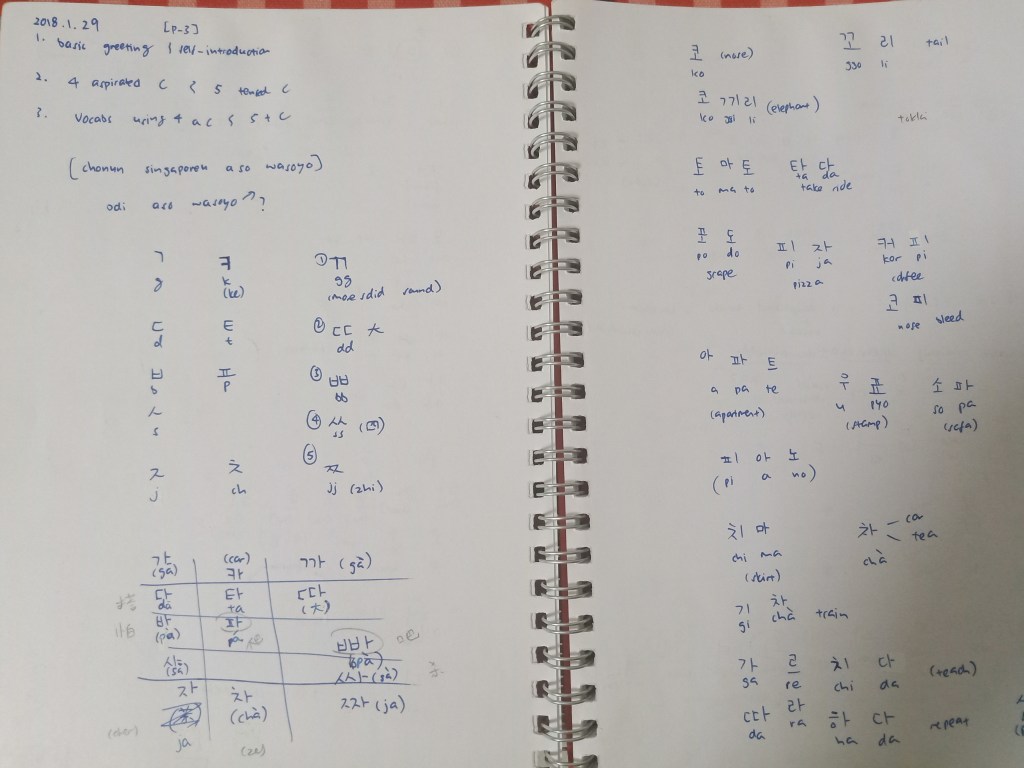
A picture of my notes
However, I encountered some problems along the way because it was not easy searching for the right images that could convey the exact meaning of the words and phrases. Nonetheless, I eventually managed to come up with flashcards that I am happy with and immensely proud of after spending some time on them. For easy viewing and organisation, I arranged the flashcards according to the types of vowels and consonants they contain which in turn determined their difficulty level.
There is also an audio function which plays a recording of a native speaker reading the terms out loud in their native language. Learners can thus visually see how the Korean terms are written and hear the correct pronunciation for them which is another reason why Quizlet is such a great platform.
In total, I made four quizlet sets and this is a screenshot of the final products:
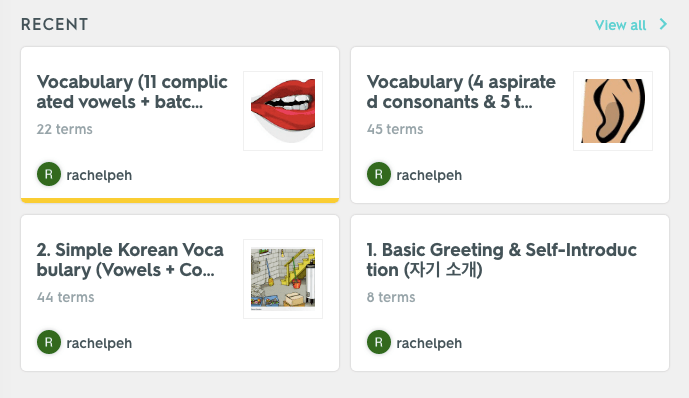
By doing so, I am joining an already vibrant community of people who have made their own sets of Quizlet flashcards for the Korean language but I had hoped to contribute with a different set of vocabulary and a more systematic way of learning by grouping these words and phrases by the different kinds of vowels and consonants used.
I had been motivated to learn Korean at first because of my love of Korean dramas and variety shows. Actually, I found that after acquiring knowledge of the Korean alphabet, I could understand what my favourite actors and idols were saying better and could rely less on English subtitles when watching their shows. Therefore, I hope that by making flashcards of simple Korean words and phrases on a public platform like Quizlet, I am able to encourage people who were new to Korean to start picking up the language. Of course, these simple words and phrases are in no way an exhaustive list of the vast vocabulary and grammar rules in the entire Korean language system but my objective is to provide materials for people like me to start somewhere. Hopefully, people who are passionate about the Korean language but are still searching for some means to learn it will find these flashcards useful.
Currently, I am also catching up on the two Korean dramas, Goblin and Hotel del Luna, to prepare for my drama analysis in the next blog update. Even though it is tough trying to find time in between my upcoming assignments and projects to watch them, I am excited to explore the treatment of death in both dramas and I cannot wait to share my ideas on this blog so do look forward to them next week!
 Rachel's Blog